Can You Stop Watching YouTube Shorts? What New Brain Research Says
A 2026 fMRI study examined immersive short-video viewing. Learn what the research found, what it does not prove, and practical ways to limit YouTube Shorts.
Content
- Why YouTube Shorts Are Difficult to Stop Watching
- What the New Brain Study Found
- What the Study Does Not Prove
- How to Stop Watching YouTube Shorts
- Set a YouTube Shorts Daily Limit With Obserra
- Frequently Asked Questions
- Conclusion
Why YouTube Shorts Are Difficult to Stop Watching
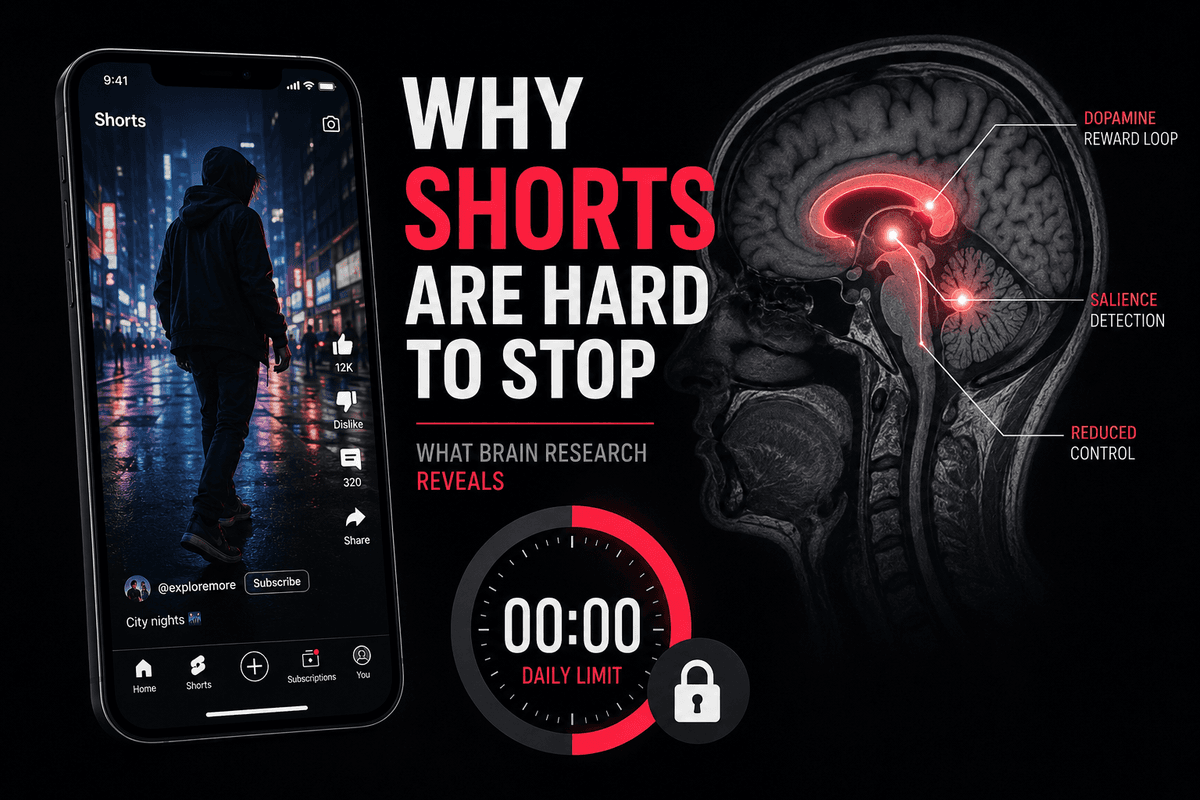
YouTube Shorts are designed for quick, continuous viewing. Each clip is easy to start, the next one is immediately available, and recommendations remove much of the effort involved in choosing what to watch. That combination can turn a short break into a much longer scrolling session.
If you have ever opened YouTube Shorts for five minutes and looked up to find that half an hour has passed, you are not alone. The problem is often not that every video is especially important. It is that there is no natural stopping point between videos.
This is why learning how to stop watching YouTube Shorts is often more useful than simply telling yourself to use YouTube less. A clear boundary, such as a daily Shorts time limit or a complete block, can make the decision easier at the moment you are most likely to keep scrolling.
What the New Brain Study Found
A study published in NeuroImage in January 2026 examined how the brain responds during short-video viewing. The researchers used functional magnetic resonance imaging (fMRI) and magnetic resonance spectroscopy to study 56 young adults while they watched short clips.
The participants viewed clips naturally and could skip a video by pressing a button. The researchers compared clips that participants watched to completion, labelled “liked” in the study, with clips that participants stopped early, labelled “disliked.”
When participants watched their preferred clips to the end, two regions associated with cognitive control showed reduced activity compared with the less-preferred clips:
- Dorsal anterior cingulate cortex (dACC), a region involved in monitoring, decision-making, and evaluating control demands.
- Dorsolateral prefrontal cortex (dlPFC), a region involved in attention and top-down control.
The preferred-video condition also produced stronger functional connectivity between the dACC and dlPFC. The researchers suggest that this may reflect coordinated, immersive processing rather than stronger cognitive control.
The study also found that resting glutamate levels in the dACC were associated with the amount of reduced activity observed during viewing. This was a correlation, not evidence that glutamate caused the brain-activity pattern.
In plain language, the findings are consistent with the idea that highly engaging short videos can shift the brain into a more automatic, low-effort, immersive mode of viewing. That may help explain why it can feel harder to interrupt a session once you are absorbed in it.
What the Study Does Not Prove
It is important not to overstate this research. The study does not show that YouTube Shorts permanently damage the brain, cause addiction in every viewer, or remove a person's ability to stop watching.
The researchers specifically note that reduced activity should not be interpreted as a failure of cognitive-control capacity. Participants were still engaged with the task and actively skipped clips they did not want to watch.
The study also has several limitations:
- It included a relatively small sample of 56 young adults.
- Participants watched experimenter-selected clips in an MRI scanner, not their normal YouTube feed.
- The researchers did not measure long-term changes in cognition or self-control.
- The study did not systematically assess problematic or compulsive short-video use.
- Watching a clip to completion was used as a measure of preference, which may not capture every reason someone keeps watching.
The most accurate takeaway is not that every short video is harmful. It is that preferred short videos can be immersive, and that immersive viewing may reduce the brain activity associated with monitoring and effort during the viewing period. More research is needed to understand the long-term consequences.
You can read the full open-access paper, Brain activity inhibition during Short Video Viewing: neurochemical insights, in NeuroImage.
How to Stop Watching YouTube Shorts
Research can help explain why Shorts are compelling, but practical boundaries are what help you change your routine. Try the approach that best matches your goal.
1. Decide on a specific daily limit
“I will watch less” is difficult to measure. A specific limit, such as 15 or 30 minutes per day, gives you a clear boundary. Choose an amount that is realistic enough to follow consistently.
2. Use a stopping point before you start
Decide when your session will end before opening Shorts. Starting with a plan is easier than trying to make a decision after an algorithm has shown you a stream of engaging clips.
3. Remove Shorts from your usual browsing path
Hiding Shorts from the YouTube homepage and removing recommendations can reduce the number of accidental sessions. You can still search for a specific video when you have a clear reason to use YouTube.
4. Block Shorts when you need a stronger boundary
If reminders and time limits are not enough, completely disabling Shorts may be the better option. Blocking the feed removes the repeated decision to stop watching.
5. Review your actual viewing habits
Look for patterns instead of relying on memory. You may discover that most of your Shorts time happens late at night, during work, or in several small sessions that add up across the day. Once you know the pattern, you can choose a more useful limit or schedule a block during that period.
Set a YouTube Shorts Daily Limit With Obserra
Obserra helps you turn an intention into a practical YouTube boundary. You can set a Daily Shorts Limit for the maximum amount of time you want to watch Shorts each day. When you reach that allowance, Obserra blocks further Shorts viewing until the next day.
You can also use Obserra when you want more than a time limit:
- Track Shorts activity to see your sessions, watch time, and number of Shorts watched.
- Use Shorts Insights to find your average daily watch time, longest session, and peak viewing periods.
- Hide recommended Shorts from your YouTube homepage.
- Disable YouTube Shorts when you want to remove access entirely.
- Combine limits with time blocks to keep YouTube unavailable during work, study, or sleep hours.
To set a limit, create an Obserra account, open Settings, and enable Daily Shorts Limit. You can then review the results in Activity and Insights.
The aim is not to make every viewing decision for you. It is to give you control at the point where an endless feed makes stopping difficult.
Frequently Asked Questions
Does watching YouTube Shorts damage your brain?
This study does not show that YouTube Shorts permanently damage the brain. It found temporary differences in activity during preferred short-video viewing and called for more research into long-term effects.
Why is it so hard to stop watching Shorts?
Shorts combine rapid content, personalised recommendations, and an almost frictionless next-video experience. This can create an immersive viewing session without obvious stopping points.
Can I set a daily limit for YouTube Shorts?
Yes. Obserra lets you set a Daily Shorts Limit and blocks further Shorts viewing after you reach your chosen allowance.
Can I block YouTube Shorts completely?
Yes. Obserra includes a Disable YouTube Shorts option for people who prefer to remove Shorts rather than manage a daily allowance.
Is this study about YouTube specifically?
No. Participants watched short clips selected for the experiment. The study provides insight into short-video viewing, but it did not test the normal YouTube Shorts feed or prove that the same effects occur for every user.
Conclusion
The 2026 NeuroImage study offers a useful explanation for why preferred short videos can feel absorbing: activity in two cognitive-control regions was reduced during immersive viewing. But it does not prove permanent harm or that viewers lose the ability to stop.
If YouTube Shorts regularly take more time than you intend, start with a measurable boundary. Create your free Obserra account to set a YouTube Shorts daily limit, review your viewing patterns, or block Shorts completely.
Keep Reading
How to Block YouTube at Certain Times for Work or Study
Learn how to block YouTube at certain times for work or study. Set up daily schedules, leave room for breaks, and check which options work on your device.
Read article
A Simple Daily Routine to Limit YouTube Shorts and Improve Focus
A simple daily routine to limit YouTube Shorts and improve focus. Exact times, limits, and tools to make every step automatic and stop losing hours.
Read article
How to Block YouTube on Your Computer: 5 Ways That Actually Work
Learn how to block YouTube on your computer with 5 proven methods - browser extension, device settings, hosts file, or router - and take back your focus.
Read article


